
Elicit Systematic Review: Now Built for PRISMA 2020
1 min read
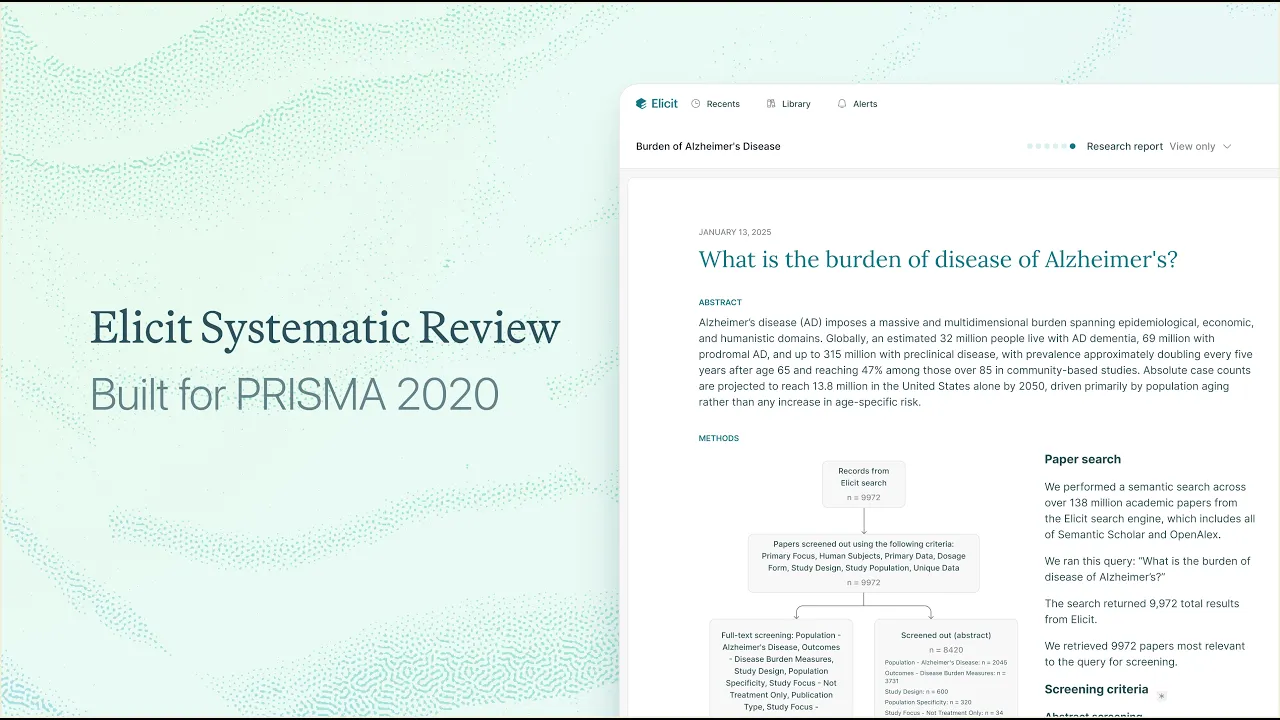
When we launched Elicit Systematic Review last year, we set out to automate evidence synthesis without compromising rigor or expert oversight. Today, we are happy to announce that Elicit Systematic Review supports PRISMA 2020 guidelines, making it reproducible, traceable, and auditable at every step.
We’re also launching our Systematic Review API to power programmatic evidence synthesis across thousands of therapeutic areas, biomarkers, interventions, and more. Elicit Systematic Review is built for those in health economics, medical affairs, market access, policy, and domains where evidence must be fast and rigorous enough to inform high-stakes decisions.
Below, we discuss upgrades to each stage of the review. For a deeper look, review our evaluation methodology. Or, explore this completed systematic review in Elicit: GLP-1 receptor agonists for efficacy and safety in adults with alcohol use disorder: a joint synthesis of consumption, alcohol-related harms, and adverse events.
Comprehensive search
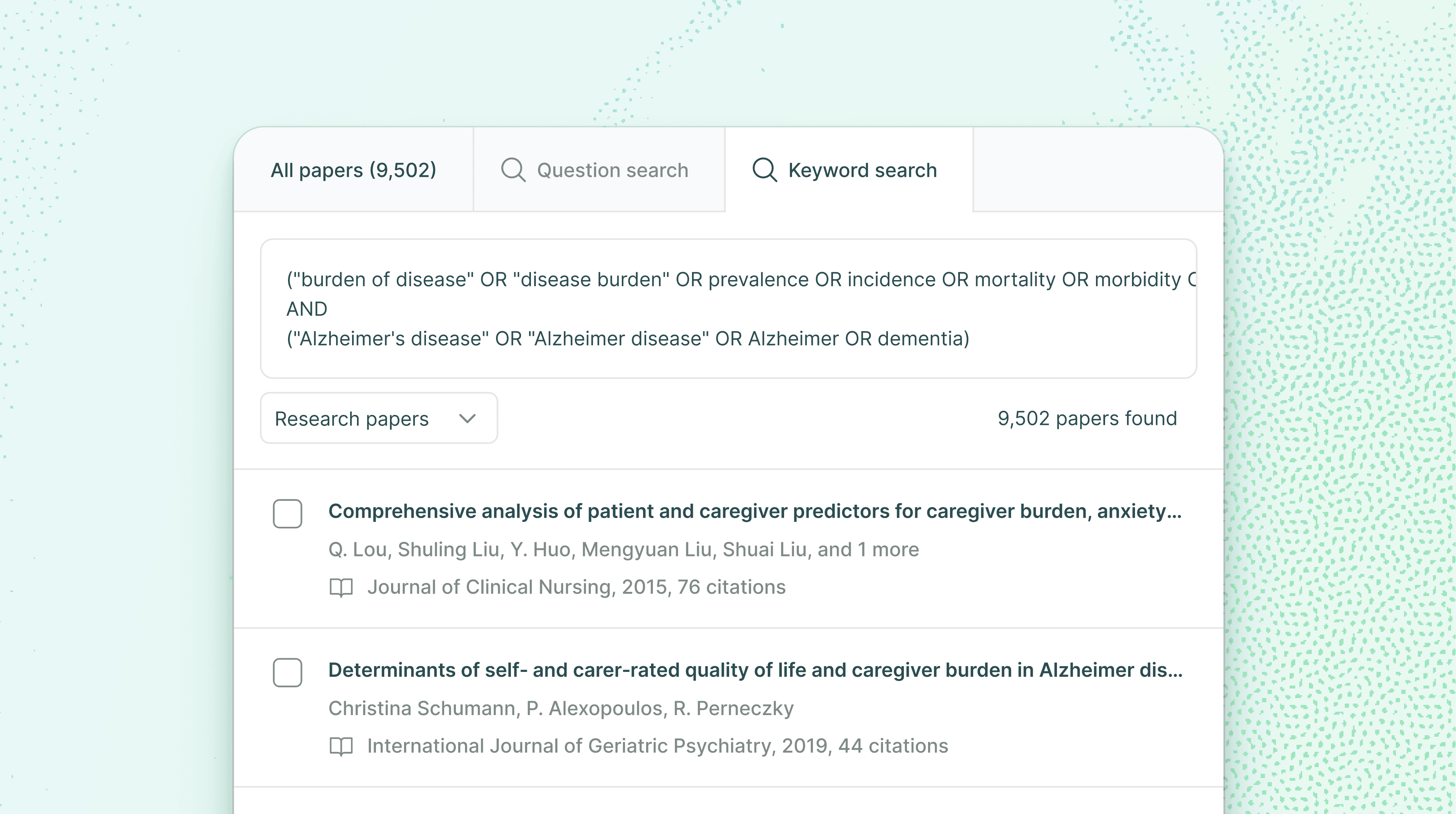
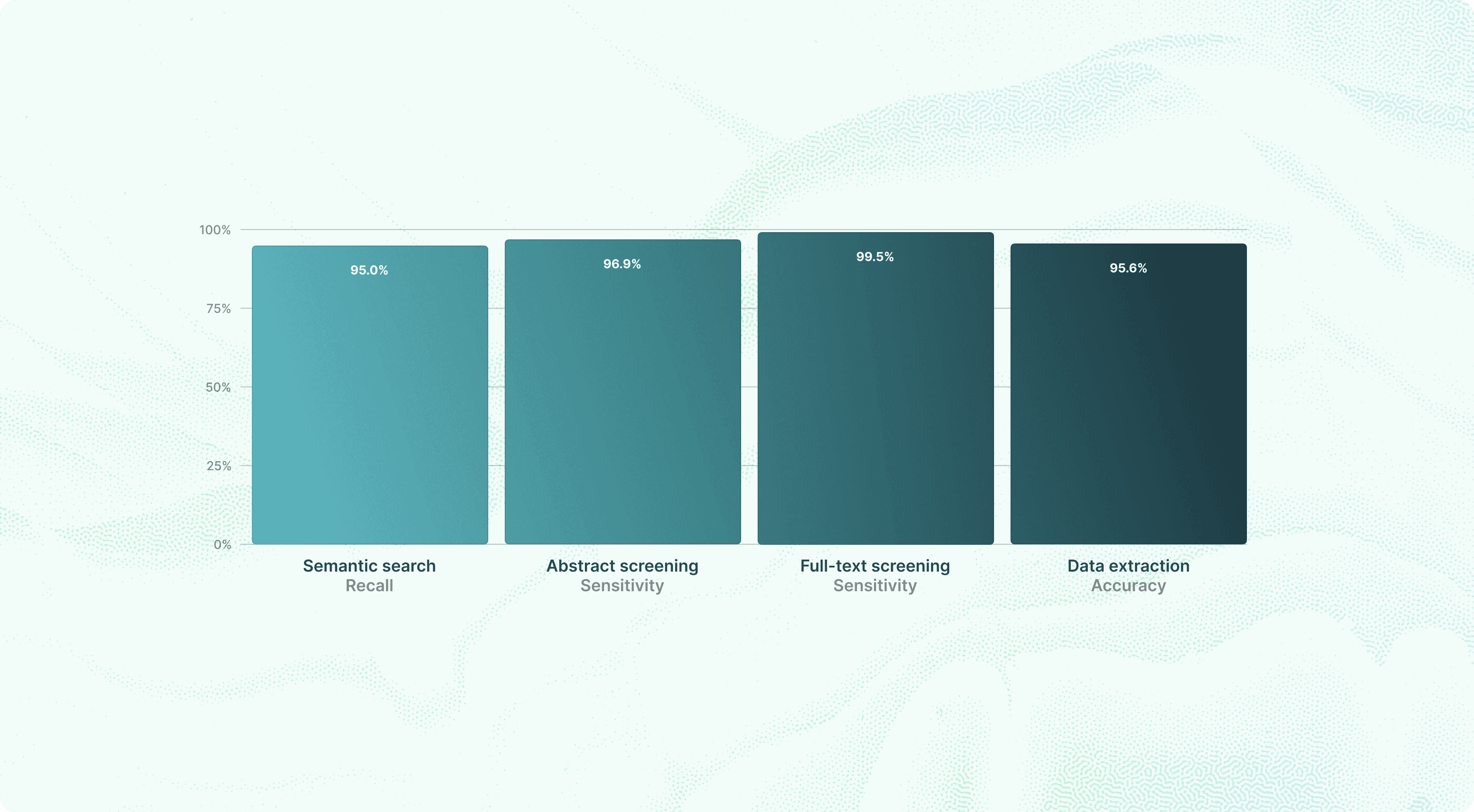
The spirit of systematic reviews is absolute comprehensiveness, transparency, reproducibility, and unbiased evidence. The letter of systematic reviews, however, often leads to brittle and overengineered keyword searches. PRISMA 2020 requires documentation of all search strategies, including databases, queries, and filters. AI-based semantic search can be more comprehensive: evaluated against 888 Cochrane reviews, a single Elicit semantic search retrieves 95% of the studies that ended up in the final review. However, semantic search is less transparent and reproducible.
Elicit can now run both. Start with multiple keyword-based search strategies to ensure reproducible comprehensiveness. Supplement with AI-based semantic search to ensure that no core papers were missed. Elicit automatically tracks and reports the searches run.
Key updates:
Gather up to 40,000 relevant papers from multiple sources: PubMed, ClinicalTrials.gov, Elicit's corpus of 138 million papers, and your proprietary databases.
Run boolean and MeSH keyword queries alongside high-recall semantic search. Keyword searches are 100% reproducible.
Aggregate and dedupe papers across multiple search strategies.
Autotranslate search strategies between keyword and semantic search across databases.
95% recall.
High-sensitivity screening
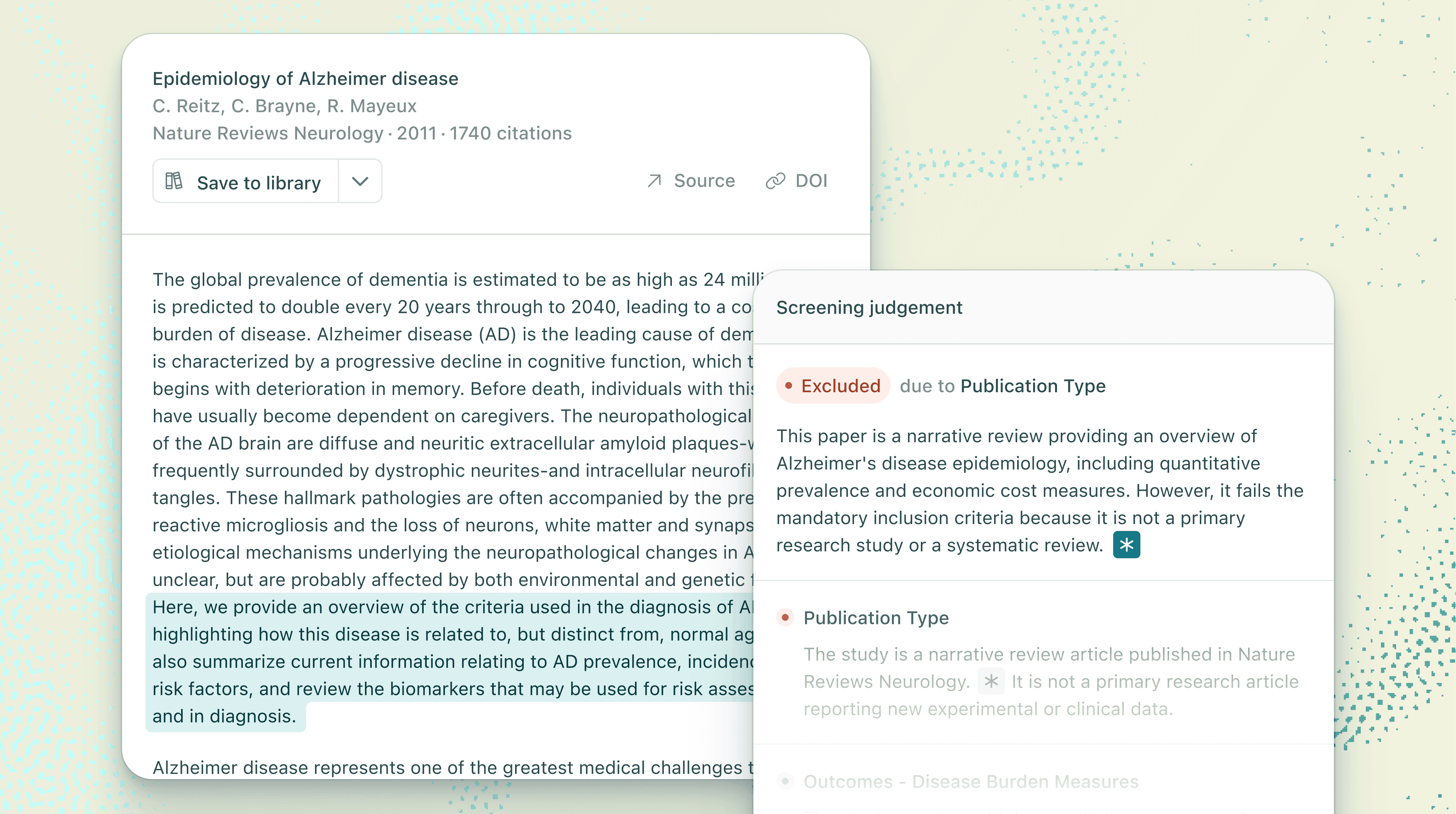
PRISMA 2020 expects documentation for all screening methods and exclusion decisions. It also expects dual review for every paper. Elicit now supports all of these requirements. Additionally, the screening models we release today achieve 97% sensitivity and 93% specificity on abstract screening. On full-text screening, Elicit achieves 99.5% sensitivity and 70% specificity. For comparison, human dual reviewers achieve 98% sensitivity and 69% specificity on abstracts. That means Elicit on its own approaches the accuracy of two human reviewers.
Key updates:
Screen up to 40,000 titles, abstracts, and full text, with automatic full-text retrieval.
Run dual review screening. Elicit’s AI screening can support two human reviewers, or be the second reviewer.
Capture exclusion reasons and supporting quotes from the paper for every screening decision.
97% sensitivity and 93% specificity on abstract screening.
99.5% sensitivity and 70% specificity on full-text screening.
“Using Elicit's traceable, explainable, and auditable Data Extraction module, I checked the accuracy of each data point in the text, detected unreadable files and unreported fields, highlighted gaps, and completed a rapid scoping review of over 100 studies in a day for a policy brief. Seeing is Believing (SIB).”
Farhad Shokraneh, PhD, SLR Methodologist, Systematic Review Consultants Ltd
Human-level extraction
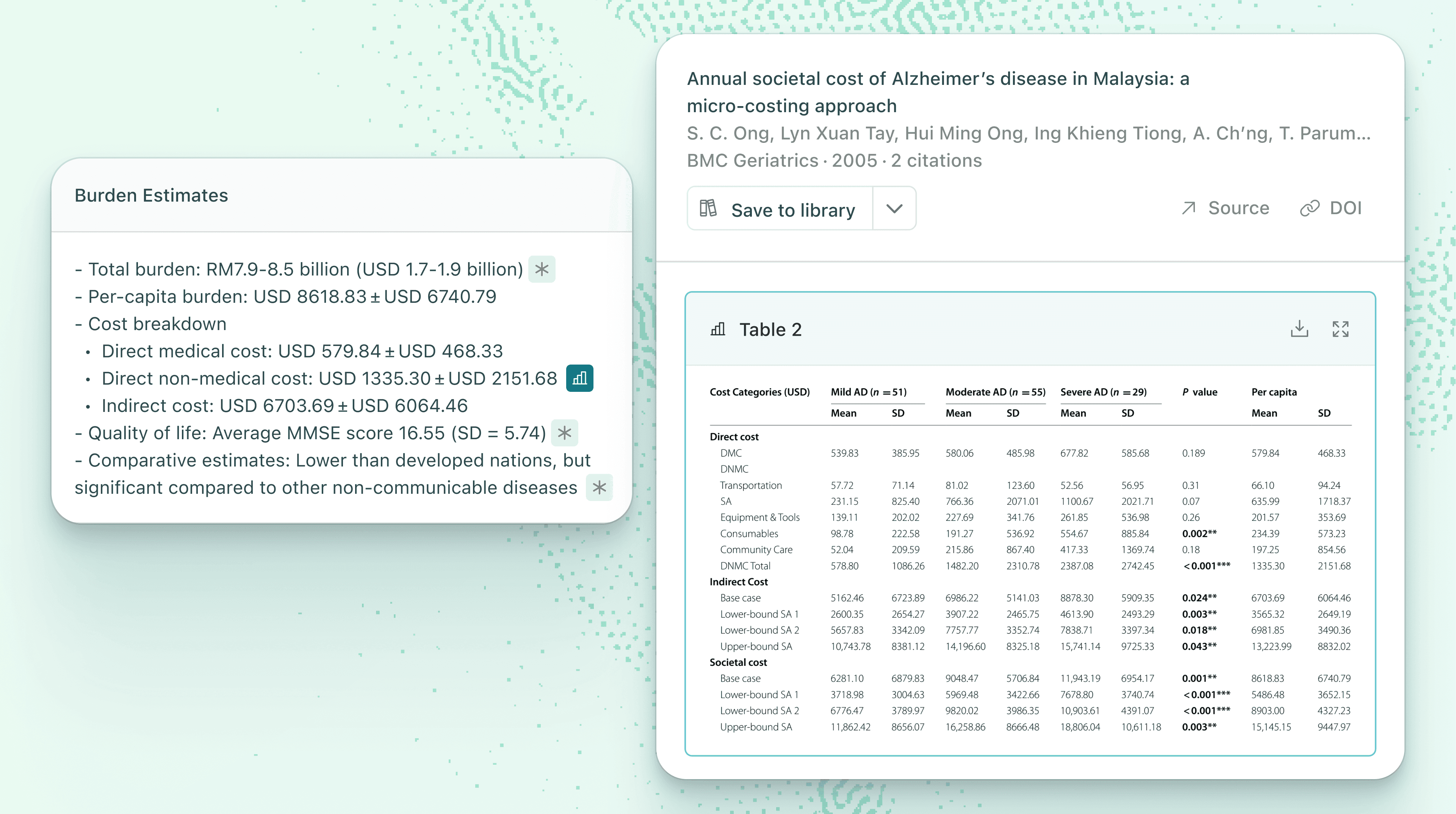
PRISMA 2020 requires verifying every extracted value. Many AI tools extract data from papers, but most don’t show specifically where each value came from. Reviewers have to check every data point manually by searching through the sources. This eats up much of the time saved by using AI. In Elicit, every extraction is 1 click away from the quotes, tables, or figures from the underlying sources, so verification doesn't offset time savings. Our extraction models achieve 96% accuracy on Methods, Participants, and Interventions extraction. In a randomized noninferiority trial (preprint), Elicit's 1.0% hallucination rate matched experienced human reviewers across 5,100 data points.
Key updates:
Extract data from up to 40,000 papers per review.
96% accuracy on Methods, Participants, and Interventions extraction.
Extract from both text and figures (charts, tables, diagrams, photos, and more), with every extraction linked to the exact section from the source.
Audit-ready reporting
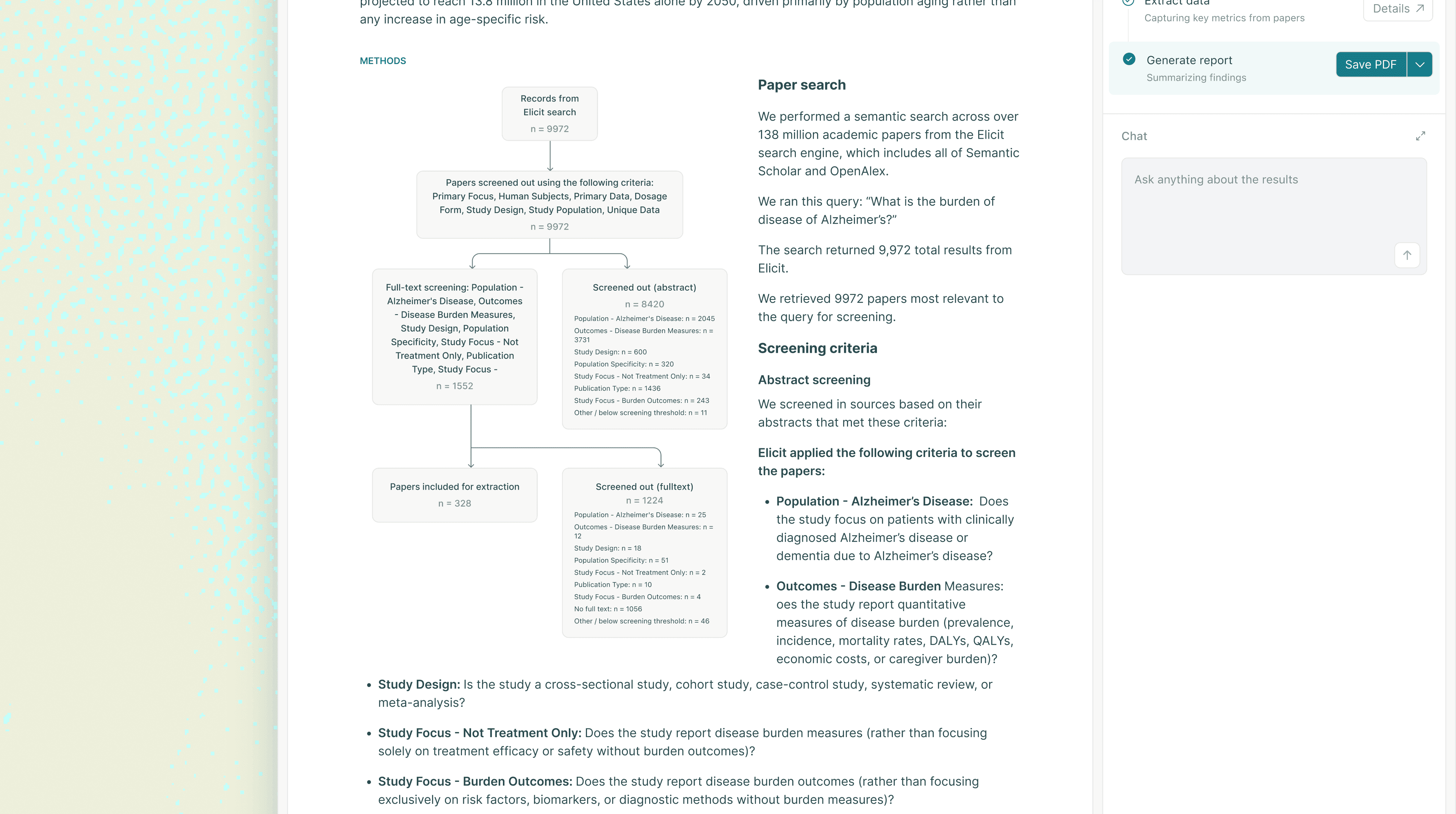
PRISMA mandates a flow diagram of the search and selection process and full tables of study characteristics. Manual reformatting and PRISMA diagrams built by hand cost time and introduce errors. Elicit exports the flow diagram, in-line citations, and structured extraction data with the report, so the final report is fully traceable to the underlying evidence.
Key updates:
Synthesize across up to 200 papers per report.
Design templates for specific types of systematic reviews (e.g., Clinical Evaluation Reports, Scientific Validity Reports), to share across the organization.
Export the PRISMA flow diagram, search strategies, and characteristics of included studies with the report.
Preserve in-line citations in PDF and Word exports.
“Being in rare disease, I search for data across decades of research. I need to compare evolving experimental designs, models, and conclusions. Elicit SLR dramatically reduces the time to get a good overview of the available studies. I can spend my valuable time working through the highlighted sources, understanding conclusions, and applying this knowledge to better my research questions.”
Heather Richbourg, PhD, Bioinformatics Scientist, Ultragenyx Pharmaceuticals
Enterprise scale
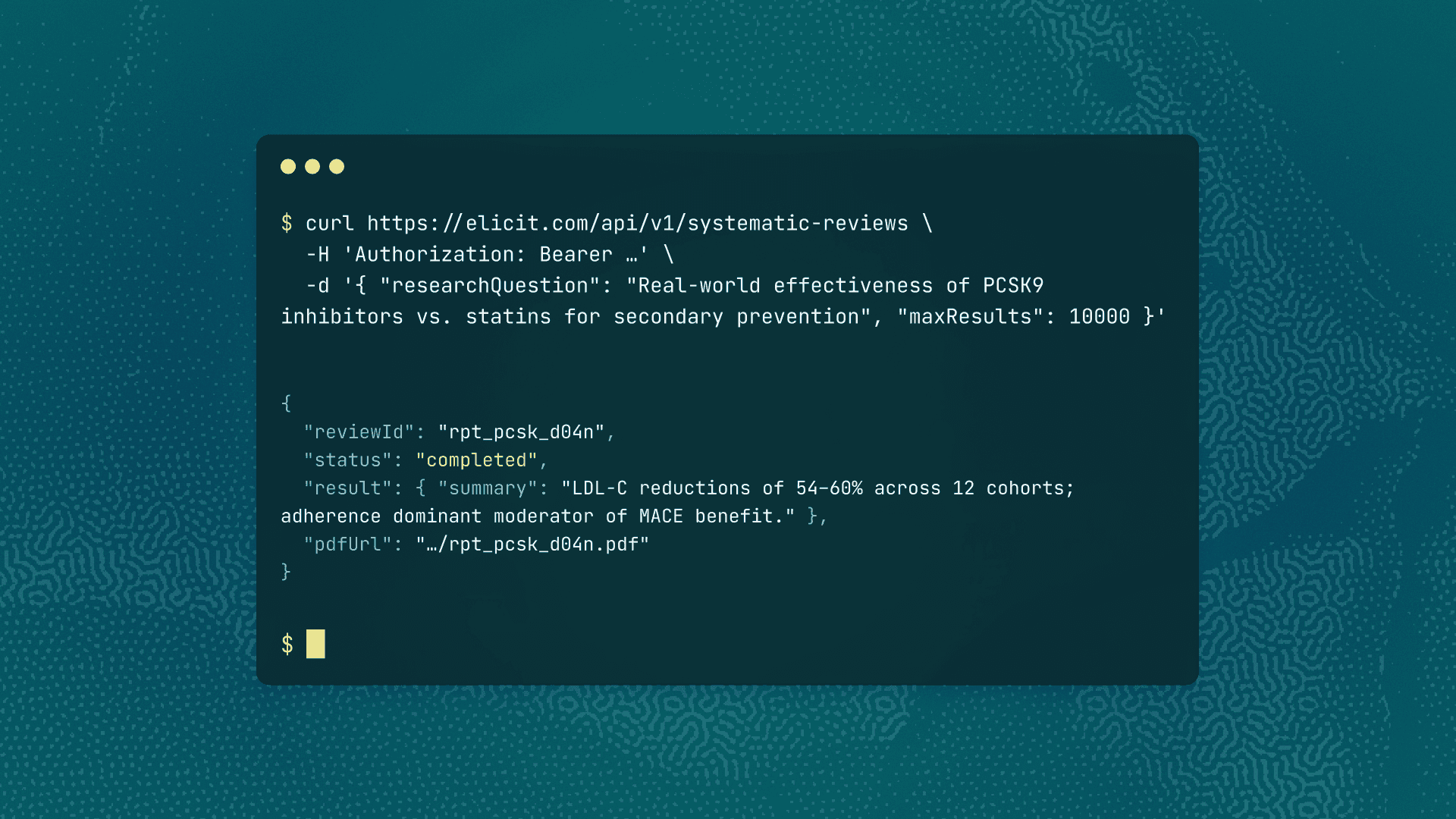
In addition to all of the improvements available via the interface, we also introduce the first Systematic Review API. With the API, teams can run evidence synthesis at an unprecedented scale. Summarizing the body of evidence over every subindication, subpopulation, biomarker, or comparator enables evidence-based strategy like never before.
The API can integrate Elicit Systematic Reviews into a broader analysis pipeline. Each response has an accompanying session URL, combining direct human oversight with programmatic scale.
Key updates:
Embed SLRs in custom pipelines and agentic workflows via the systematic review API.
Use the Elicit Search API to define your protocol and search strategy, and then use that to run your Systematic Review.
Run systematic reviews across entire research portfolios, not one at a time.
The future of evidence synthesis
Systematic reviews are falling behind the evidence they're meant to synthesize. Of 8,477 systematic reviews published between 2003 and 2024, 64.3% have never been updated. For those updated at least once, the median interval is 57.2 months. They simply cannot keep up with the pace of evidence generation and decision-making of our current time.
But generic AI tools like Claude, ChatGPT, Copilot and Gemini have serious pitfalls that make them unusable for systematic literature reviews (SLR). These include:
All of these share a root cause. Generic tools don’t follow a standardized step-by-step process, with reproducible search, documented exclusion, and traceable extraction. PRISMA isn't a checklist you can just bolt onto an output; it's a property of the process that produced it. Elicit is built for that process with our long-held beliefs on transparent reasoning, process supervision, and factored verification.
What’s next
The core systematic review workflow — search, screening, extraction, and synthesis — is available for Pro, Scale, and Enterprise customers. Today's launch elevates the core Systematic Review experience by introducing dual review, API access, exclusion reasons, and new screening and extraction models. All Elicit Enterprise customers now have access to these new features. Elicit Scale users who sign up in the next 30 days will receive 1 trial review with all of the new capabilities. To learn more, connect with our sales team.